
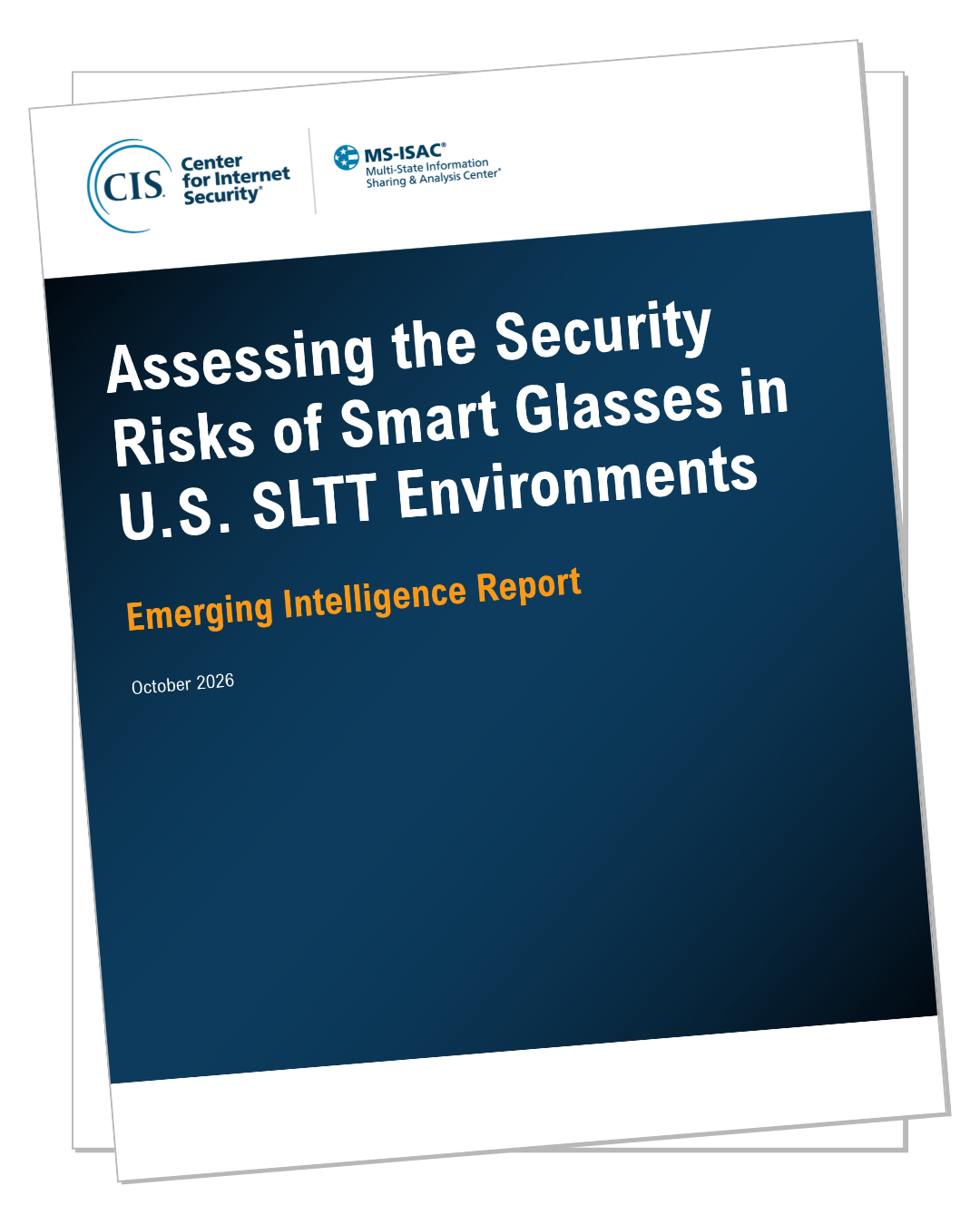
Assessing the Security Risks of Smart Glasses in U.S. SLTT Environments
Published on November 5, 2026
Analysts at the Center for Internet Security® (CIS®) analysts assess unauthorized, opportunistic, or malicious actors will likely leverage consumer smart glasses to support covert surveillance, unauthorized recording, reconnaissance, and information collection across public, workplace, and sensitive environments. This activity increases the likelihood of credential theft, privacy violations, extortion, and the unauthorized disclosure of sensitive information. Analysts make these assessments with moderate confidence based on federal government and law enforcement reporting, open-source reporting, and user-generated content.
Consumer smart glasses pose cross-sector risks by enabling covert data capture and real-time information access, which increases opportunities for misuse of captured content. These devices also limit organizational visibility into how sensitive data is stored, processed, or shared.
To mitigate these risks, U.S. State, Local, Tribal, and Territorial (SLTT) government organizations should train staff to recognize smart glasses and companion devices, update recording device and visitor policies, and review controls governing sensitive environments. For additional guidance, see the "Recommendations" section in our white paper.
As of June 23, 2025, the MS-ISAC has introduced a fee-based membership. Any potential reference to no-cost MS-ISAC services no longer applies.